
What is the Yamazumi Chart ?

Your personal data will be processed and information from your device (cookies, unique identifiers, and other device data) may be stored by, accessed by and shared with 141 TCF vendor(s) and 69 ad partner(s), or used specifically by this site.
Some vendors may process your personal data on the basis of legitimate interest, which you can object to by managing your options below. Look for a link at the bottom of this page or in the site menu to manage or withdraw consent in privacy and cookie settings.
Introduction

A Yamazumi chart (or Yamazumi board) is a stacked bar chart that shows the source of the cycle time in a given Process. The chart is used to graphically represent processes for optimization purposes.
Overview
Yamazumi is a Japanese word that literally means to stack up.
Process tasks are individually represented in a stacked bar chart, these can be categorized as either Value Added, Non-Value Added or Waste. The mean duration time of each task is recorded and displayed within the bar chart. Each process task is stacked to represent the entire process step.
The axes of the Yamazumi chart are as follow:
y axis represents cycle time.
x axis represents each process step.
Often, a target cycle time (mean cycle time) will be plotted to aid line balancing activities.
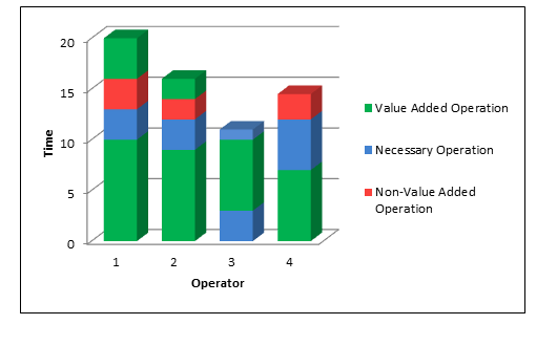
The Yamazumi chart can be used for both process Waste Elimination or Line Balancing activity. Process steps can be rearranged or deleted to optimise and balance the target process.
The tool is intended to support Business Process Improvement teams, it is also a useful Lean training aid.
Yamazumi charts are used by Lean improvement teams throughout many process driven organizations.
Benefits
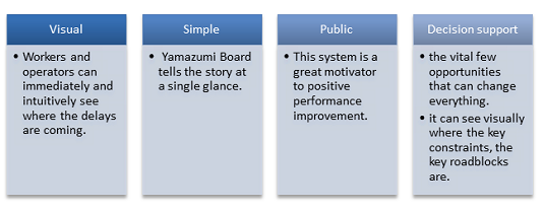
You can simulate and do exercises
Free inspired by: